“You can’t fix what you don’t see. You don’t know what you don’t know. We see opportunities others miss. We do what others don’t. Winning together is our goal” – Bill Rusteberg
By Mike McLain
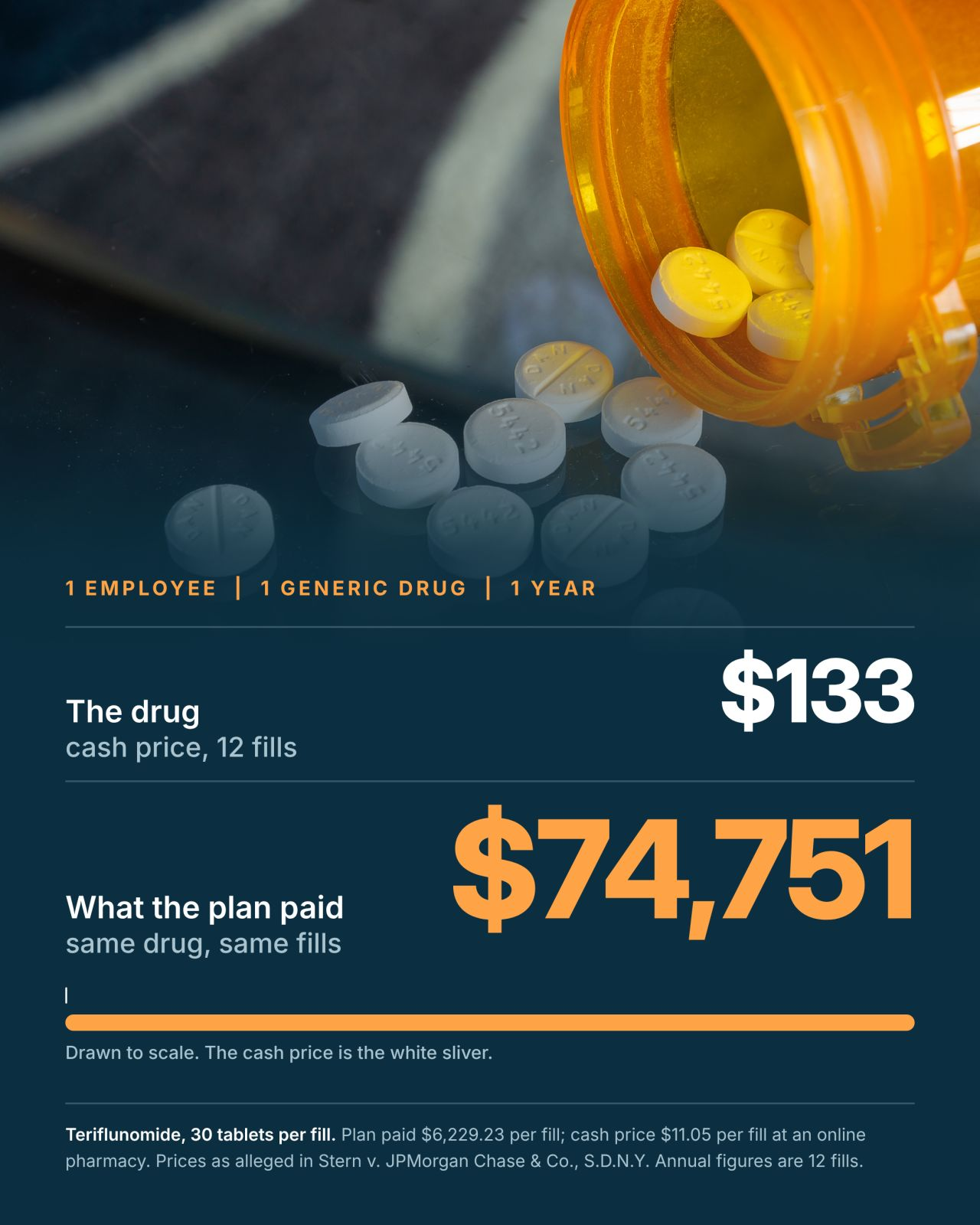
The drug costs $133 a year at cash price. The JPMorgan plan paid $74,751…….1 employee. 1 generic drug. 12 fills.
Per fill, 30 tablets of teriflunomide:
→ Cash price, online pharmacy: $11.05
→ What the plan paid: $6,229.23
→ The gap: $6,218.18
That is the price alleged in Stern et al. v. JPMorgan Chase. The PBM was CVS Caremark.
In March 2026, a federal court let the case proceed and said it plainly: “The selection of a service provider is a fiduciary function.” The PBM is not the one being sued. The employer that selected it is.

Why that matters to you:
- If you are self-funded, the gap is your money… pure margin that you’ll never see. It leaves your account with every claim.
- Your employees pay it too, through premiums and cost sharing.
- You are the fiduciary. The PBM is not the one being sued.
CFOs and CHROs: how confident are you that this isn’t happening to your plan?
You can get in your car with your paper prescription, travel from one pharmacy to another asking the price, and you will likely be amazed how much the price difference can be between stores. Or, you can present your group plan pharmacy card you’ve always had, and Greenback Health can do that for you at the point of service in less time than you can say, “What took so long!”
The price for the same prescription drug can vary by hundreds or even thousands of dollars, depending on where you buy it, according to a new report by the U.S. Public Interest Research Group which surveyed hundreds of pharmacies and found large price differences for identical medications.
One study found consumers could save anywhere from $100 to $5,400 a year just by price shopping. In Ohio, they found the same inhaler being sold for $11.99 at one pharmacy and $1,136 at a different pharmacy. In North Carolina, a generic medicine to lower cholesterol could cost $7 or $393 depending on where it was purchased.
It’s a rigged system. We read about various strategies “experts” promote to reduce drug spend such as step therapy and pre-authorization but they don’t work. Drug costs keep going up.
The best strategy proven to work is to stop paying for expensive drugs. A small county in Texas did that four years ago, eliminating all brand name drugs from their plan.
Plans can capitate 500 generic drugs for about $7 pepm and it will fill the prescription needs for almost every ailment known to man. Compare this to your current Rx spend on a pepm basis. You will be shocked.
Other plans are eliminating specialty drugs.
HOMEWORK READING ASSIGNMENT:
Drug Price Check In Cuero, Texas
Script Sourcing Third Party Ven– Risk Managers
Generic Drugs Should Be Cheap, but Insurers Are Charging Thousands of Dollars for Them
Middlemen Pocket 70% of Medicare Spending On Widely Used Generic Drugs, Study Finds